Independent DELMIA Apriso testing from a dedicated QA department
Andea provides independent DELMIA Apriso testing through a dedicated QA department that works alongside its implementation consultants on every project. Consultants test their own code, as they should; Andea's 30+ testers then run formal module, functional and integration testing on every build, bringing a separate set of eyes.
Apriso knowledge from day one. Andea's testers work inside an organization that implements DELMIA Apriso for manufacturers across many industries. They already know how Apriso behaves, where it tends to break and how its modules connect to ERP and shop-floor platforms, so the client does not pay for that learning curve with its own time and budget.
Systems built by other integrators. Because Andea's testers work independently of implementation teams, the same expertise applies to Apriso environments delivered by other partners. Taking over such environments is routine: they make up more than half of Andea's active maintenance projects.
Testing is one of Andea's manufacturing software services, alongside consulting, implementation, and application maintenance and support. The same team keeps testing after go-live, through upgrades, hotfixes and configuration changes.


Manufacturing software testing scope: MES, ERP and shop-floor systems
Andea's manufacturing software testing covers four layers: the DELMIA Apriso MES/MOM platform (primary specialization), ERP integrations (SAP, Microsoft Dynamics 365 and others), shop-floor automation (PLC, SCADA, equipment-level systems) and multi-system environments in which an MES connects to several external platforms. Most testing stops at the MES boundary, yet a defect at any integration point can stop a production line just as an internal MES defect can.
- MES/MOM layer: DELMIA Apriso modules, business processes, configurations and custom extensions, tested before go-live and after every upgrade.
- ERP layer: SAP and Dynamics 365 interfaces – production order, material and inventory data exchange, checked for data mapping and timing errors.
- Shop-floor layer: PLC, SCADA and equipment signals. When real equipment is not available, Andea's Automation Simulation tool simulates machine signals at the OPC server level, so the MES behaves as if the equipment were connected.
- Multi-system landscapes: other external platforms connected to the MES, tested end to end across every interface
Andea's goal is that the manufacturing system behaves correctly before it goes live, not after.
Manual MES testing for DELMIA Apriso go-lives and upgrades
Manual MES testing is a structured check that a DELMIA Apriso system meets the client’s business requirements. Testers, not scripts, run it before every go-live and version upgrade. This is the core of Andea’s testing work: preparing test data, working through configurations and operations, and walking every process end to end across all modules – edge cases included, because real production will hit them sooner or later.
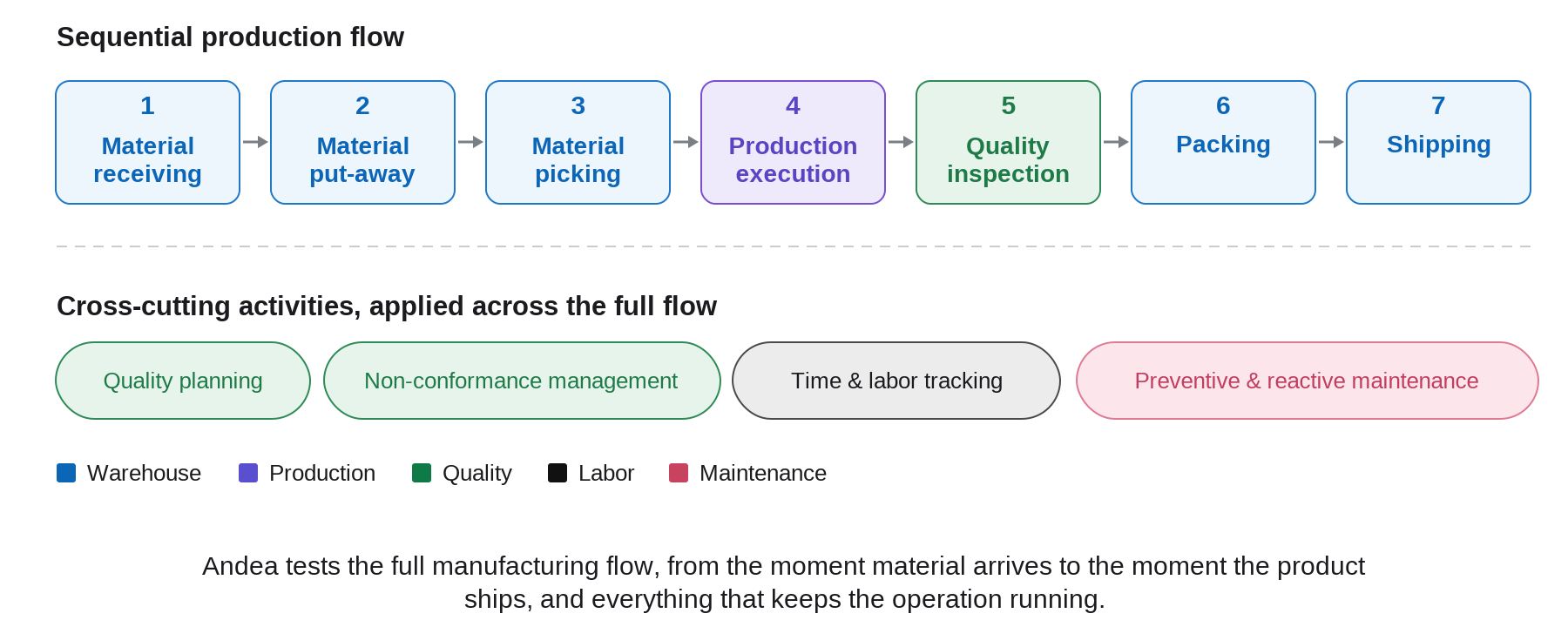
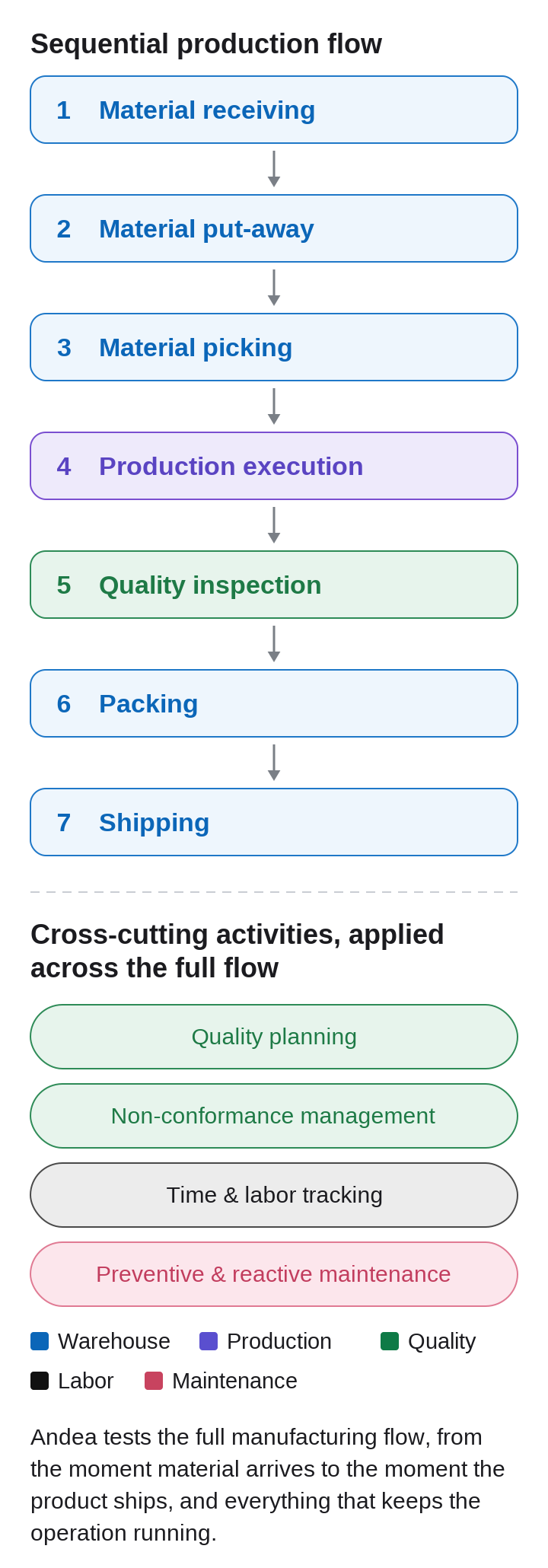
Andea's manual testing covers the whole flow as it runs in Apriso: material receiving, put-away and picking, production execution and quality inspection, through to packing and shipping. It also covers the activities that span the entire flow: quality planning, non-conformance management, time and labor tracking, and preventive and reactive maintenance.
This work demands broad business knowledge and precision, while internal IT staff are usually busy running the rollout. Andea's dedicated testers know what correct behavior looks like in an Apriso environment, and they can tell a configuration gap from a genuine defect. The difference matters: a configuration gap needs a process conversation, a defect needs a fix, and confusing the two wastes time on both sides.
Types of manufacturing software testing Andea covers
Andea covers eight types of manufacturing software testing: module, functional and business process, integration, regression, user acceptance (UAT), performance, GMP and validated environment testing, automated MES testing.
A defect can enter a manufacturing system at many points – in a newly delivered module, in the data passing between MES and ERP, or in a configuration change made months after go-live – and each type of targeted testing checks one of those points before it reaches the floor.


Module testing verifies each new DELMIA Apriso module as it is delivered. Andea's testers run it alongside development, so defects surface early, while they are still cheap to fix.

Functional and business process testing checks full end-to-end flows across the critical manufacturing processes: production order creation and execution, quality inspections, warehouse transactions and others. Andea's testers verify each flow against the client's business requirements, not only against screen-level behavior.

Integration testing (system integration testing) checks the data exchange between the MES and external systems such as SAP, other ERP platforms and shop-floor systems. Andea tests the interfaces and APIs between DELMIA Apriso and those systems directly, checking data mapping, message timing and error handling in both directions, because a mismatch between two systems causes problems that testing either system alone would miss.

Regression testing verifies that an upgrade, hotfix or configuration change has not broken existing DELMIA Apriso functionality. Andea runs regression suites after every release and, for multi-site clients, separately per environment, covering each site's specific configuration. With the Andea Auto Test Engine, one automotive client cut a regression cycle from two weeks to three hours across 600+ automated test steps. Regression matters because an unnoticed change can carry real consequences straight into production.

User acceptance testing (UAT) is the final check, in which the client's own users validate that the system supports their daily work before go-live. It is where many implementations hit trouble: client teams are asked to validate a system they have not used before, often under pressure with go-live approaching. Andea takes that burden off the client, from designing the UAT plan and preparing test scenarios, to facilitating execution and training the internal team to run it themselves. The goal is a UAT process the client feels confident in, not one they just get through.

Performance testing checks that the MES stays responsive under real load. For one automotive client, Andea built a custom performance testing framework to validate 2,500 concurrent users across three time zones before go-live. Andea's Auto Test Engine also tracks response time on every Apriso action, which gives a built-in performance baseline and flags slowdowns before they reach the floor.

In regulated industries that operate under GMP (Good Manufacturing Practice), testing has to produce a complete documentation package: execution evidence, screenshots at every step and deviation logs. This is far heavier than standard testing. Andea covers GMP testing both manually and through its Auto Test Engine, which collects that documentation quickly, accurately and repeatably, removing the manual effort that otherwise makes this work slow and error-prone.
Automated MES testing with the Andea Auto Test Engine
Automated MES testing runs repeatable test scenarios against DELMIA Apriso without manual execution. Andea's Auto Test Engine is a framework with pre-built Apriso components, so once the first business flow is developed and covered, every subsequent automated test scenario follows in five to seven days. Building the same script from scratch, before the framework existed, took one to two months.
Pre-built components cover the business flows most Apriso clients run: production order creation and execution, OEE (Overall Equipment Effectiveness), receiving and warehouse management. The engine is built on Python, Selenium and pytest and can run inside the client's CI/CD pipeline, so automated tests run with every build. The client owns the test scenarios and components built for its system and can run, maintain and extend them independently, with its own team or another provider, also after the engagement ends. Andea maintains and develops the framework itself.
The Auto Test Engine can also be integrated with Andea MES IQ, Andea's AI assistant for MES software. MES IQ connects to the MES database through API connectors, answers questions asked in plain language and keeps all data inside the client's own environment.

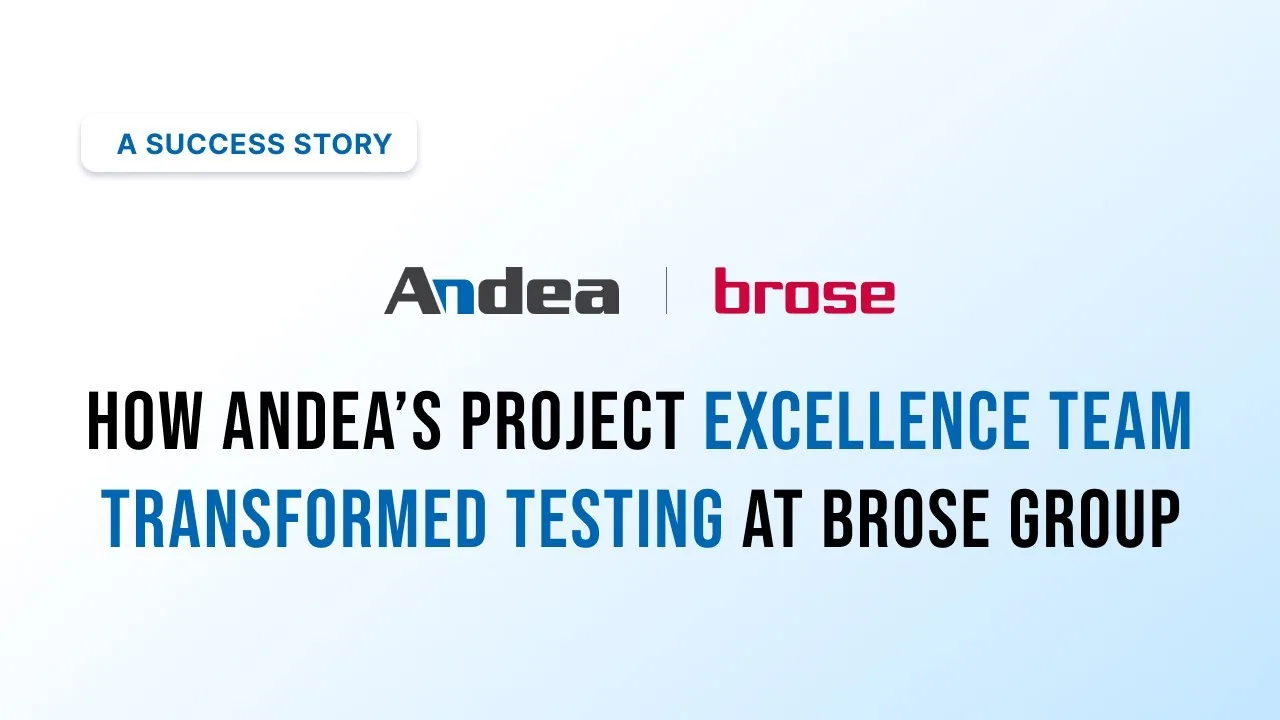
Transforming Brose Group’s manual testing process with Andea’s automated framework
See how Andea automated MES testing for Brose and cut a regression cycle from two weeks to three hours: read the Brose case study.

How much do manufacturing software testing services cost?
The cost of manufacturing software testing services depends on four factors: the number of systems and integrations in scope, the share of manual versus automated testing, the number of environments and sites, and the engagement model.
Automation changes the cost curve. With Andea's Auto Test Engine there is no license fee: the client pays for Andea's services, such as installation, setup and configuration of automated test scenarios. Every scenario after the first covered business flow takes five to seven days instead of one to two months. For repeating work such as regression after every release, a regression cycle that took two weeks dropped to three hours at one automotive client.
Andea scopes every engagement individually, after reviewing the environment, the systems involved and the testing types required.
How a manufacturing software testing engagement works
An Andea testing engagement starts with access to the client's environment and an agreed scope; for manual engagements, the timeline is defined at kickoff based on that scope.
Andea and the client agree which systems, modules, interfaces and test types are in scope, and Andea gets access to the test environment.
Andea's testers prepare the test plan, test cases and test data, based on the client's business requirements and traced back to them in a requirements traceability matrix.
Testers run the test cases manually or through the Auto Test Engine and log defects with severity and reproduction steps. Andea separates configuration gaps from genuine defects, so each finding goes to the right place.
Andea delivers execution evidence, a defect summary and a test report; for GMP clients, the full documentation package.
Fixed defects are retested, and regression runs after every upgrade, hotfix or configuration change.
ISTQB-certified manufacturing software testers
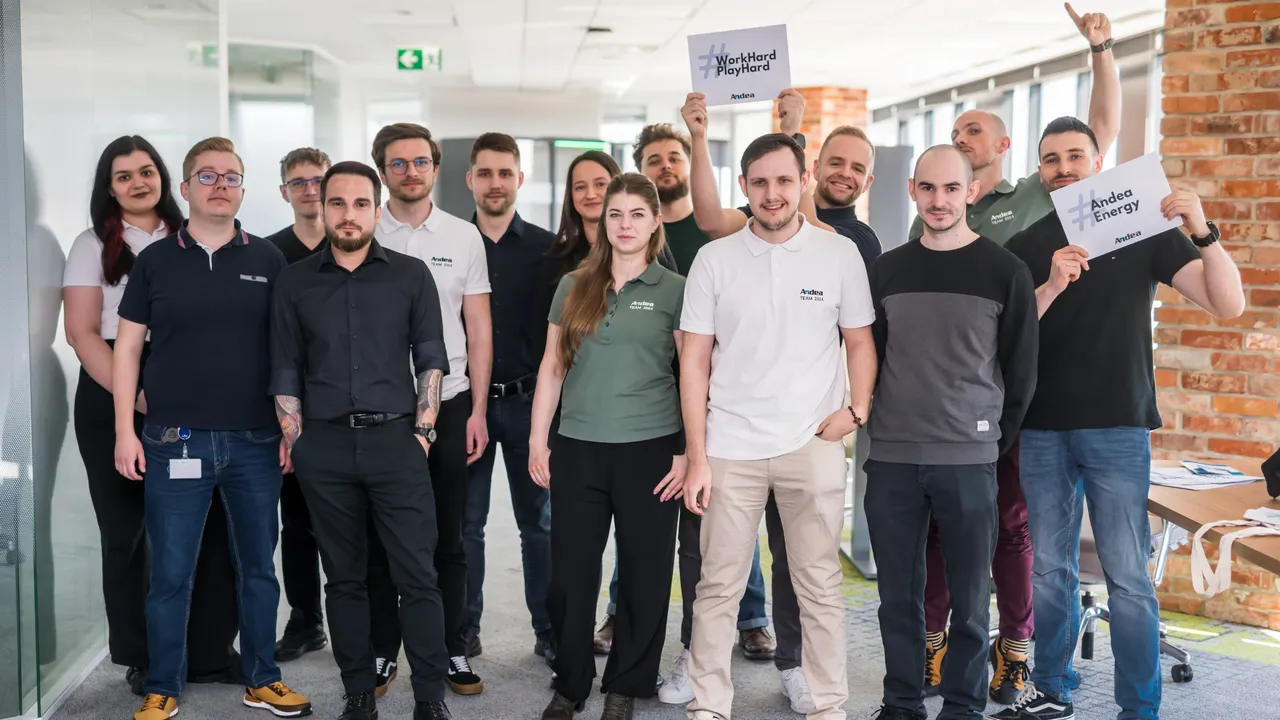
Andea's testing team consists of 30+ certified testers who work exclusively in manufacturing software: MES/MOM platforms, ERP integrations and shop-floor systems. That focus is what makes the difference. Andea's QA and testing processes are built on ISTQB methodology, which keeps service delivery, change handling and incident management consistent from one engagement to the next.
Andea's testers hold the following qualifications, among others:
- ISTQB® Certified Tester Foundation Level (CTFL)
- ISTQB® Certified Tester Advanced Level – Test Management (CTAL-TM)
- ISTQB® Certified Tester Advanced Level – Test Automation Engineering (CTAL-TAE)
- ISTQB® Certified Tester Advanced Level – Agile Tester (CTAL-AT)
- AgilePM® Foundation
- ITIL® Foundation Certificate in IT Service Management
Every year, Andea's testing team delivers MES testing projects for clients in automotive, aerospace, medical devices, FMCG and industrial manufacturing across the US, Germany, Poland, the rest of Europe and Asia.
What clients say about Andea's manufacturing software testing
Two Andea clients describe the impact of testing on their MES projects in their own words.
“The accuracy and consistency of Andea’s test automation helped us identify and resolve issues early in the development cycle, which prevented costly fixes later on. This proactive approach not only saved us money but also improved the overall quality of our products, enhancing user satisfaction and reducing post-release support efforts.”
“Thanks for your invaluable support in MES Stage 3 (RBZ) deployment. As a result of thorough user acceptance testing, and careful cutover planning, the deployment was smooth, with no significant impact on business operations.”
Read the Tokai COBEX case study
MES testing across manufacturing industries
Andea has tested MES projects in automotive, aerospace and defense, FMCG and specialty materials. Engagements range from focused project support to partnerships that have run for years and spanned dozens of production sites worldwide. Across all of them, automation measurably shortens testing cycles, and Andea has carried clients through hundreds of successful go-lives. Each industry brings its own quality framework, such as IATF 16949 in automotive, AS9100 in aerospace and defense and GMP in FMCG, and Andea's test documentation follows the framework the client works under.
Andea's automotive testing engagement automated 600+ test steps and cut a regression cycle from two weeks to three hours. Andea also built a custom performance testing framework to validate 2,500 concurrent users across three time zones before go-live, and embedded automated testing into every sprint from day one.
In an FMCG engagement, Andea has tested for seven years across eight factories, delivering full GMP documentation for every go-live. Manual and automated testing run consistently across every site, with each documentation package adapted to the client's specific regulatory requirements.
For an aerospace and defense client, Andea runs functional, integration and regression testing across production execution, quality, warehouse and compliance modules, continuously through every agile sprint. Testing coverage was maintained as the solution scaled across multiple manufacturers under a code-sharing agreement.
For a specialty materials client, Andea embedded quality-first testing from day one, developing system and business test cases in real time alongside each sprint. The result was near-zero defects at go-live across multiple UAT rounds, in a partnership spanning 20+ production sites worldwide.
Manufacturing software testing FAQ: scope, systems and types
Manufacturing software testing services verify that the systems running production – MES/MOM platforms such as DELMIA Apriso, the ERP integrations around them and shop-floor systems like PLC and SCADA – work correctly before go-live and after every upgrade, hotfix or configuration change. They are a specialized form of software quality assurance (QA), often delivered as outsourced QA for manufacturers that lack dedicated MES testers. Unlike generic software testing or QA testing services, they need testers who understand how production processes actually run on the floor, so they can tell a configuration gap from a genuine defect.
QA (quality assurance) in manufacturing software is the set of practices that verify production systems meet their specified requirements before and after go-live. It covers the MES, its ERP integrations and shop-floor systems, and it differs from QA in the production process itself (product quality inspection), which an MES executes but does not replace.
DELMIA Apriso is Andea's primary specialization. Andea's testers also test ERP integrations (SAP, Microsoft Dynamics 365 and others), shop-floor automation (PLC, SCADA) and multi-system environments in which an MES connects to several external platforms.
Andea covers module, functional and business process, integration, regression, UAT, performance, and GMP and validated environment testing, plus automated testing through its own Auto Test Engine. For shop-floor scenarios, Andea's Automation Simulation tool simulates machine signals at the OPC server level, so the MES behaves as if real equipment were connected. The Auto Test Engine connects to OPC servers through its OPC UA plugin.
No. Andea's testing focuses on functional, integration, regression, performance and GMP testing of manufacturing systems. Security testing of OT environments, for example against IEC 62443, requires specialized security providers, and Andea can coordinate with them during a project. Andea's own DELMIA operations are audited under SOC 2 Type II.
Manufacturing software testing FAQ: GMP, getting started and providers
Andea delivers testing in GMP-regulated environments, including the full execution evidence and documentation package required for certification. Andea does not provide standalone GMP validation consulting.
For automated testing, Andea delivers the first test scenario within days of completing the first functionally covered business flow, given access to the environment and an agreed scope. For manual engagements, Andea defines the timeline at kickoff, based on the agreed scope. In both cases Andea's testers get productive on a client's system fast, because the DELMIA Apriso domain knowledge is already there.
Yes. Apriso is Andea's primary testing specialization, and its testers work independently of implementation teams, so the same expertise applies to systems built by other partners. Taking over environments implemented by others is routine: they make up more than half of Andea's active maintenance projects, and customized setups are in scope. Andea needs access to the environment and an agreed scope to get started.
Manufacturers test in-house when they have dedicated testers who know both the MES and the production processes. They outsource when internal IT is busy running a rollout or upgrade, or when the project needs a specialist team for a limited time. Outsourcing to a provider that implements and supports DELMIA Apriso, as Andea does, adds independent testing and system knowledge without long ramp-up.
Look for testers who know the specific MES platform and the production processes it runs, not only general QA methodology. Other signals are certified testers (ISTQB), experience with ERP and shop-floor integrations, documentation that meets GMP requirements where needed, and clear ownership of any automated test code after the engagement ends.
Andea has offices in Poland, the United States, Germany and Mexico. Its testers work remotely for clients in the US, Europe and Asia.
Andea's testing sits alongside consulting, implementation, and application management and support. Because the same organization implements and supports Apriso, Andea's testers bring that system knowledge into every engagement, and the same team can keep testing after go-live, through upgrades, hotfixes and configuration changes.
Manufacturing software testing FAQ: Auto Test Engine, AI and cost
No. Built on Python, Selenium and pytest, Andea's Auto Test Engine started with Apriso, where Andea's domain knowledge runs deepest, and extends to automate other manufacturing systems and their integrations. Andea develops the framework continuously, and each client's data and business logic stay in that client's own test suite.
No. There is no license fee for the Andea Auto Test Engine: the client pays for Andea's services, such as installation, setup and configuration of automated test scenarios. The framework is built on open technologies (Python, Selenium and pytest), with no third-party commercial licenses. The client gets full rights to use it, owns its test scenarios and can run and maintain them independently. Andea maintains and develops the framework, and updates to new versions are agreed with the client.
No. AI tools can speed up test design and repetitive checks, but testing manufacturing software still requires testers who know the production process. Only they can judge whether an MES behaves correctly on the floor and tell a configuration gap from a genuine defect. Andea's Auto Test Engine can be integrated with Andea MES IQ, Andea's AI assistant for MES software, so AI supports the testers' work rather than replacing it.
The cost depends on the number of systems and integrations in scope, the mix of manual and automated testing, the number of environments and sites, and the engagement model. Andea's Auto Test Engine has no license fee. See How much do manufacturing software testing services cost? for the cost factors.
Talk to Andea's manufacturing software testing team
Preparing for an Apriso go-live, planning a version upgrade, or dealing with a testing gap left by a previous provider? Talk to Andea's testers about what proper MES testing looks like for your environment.
